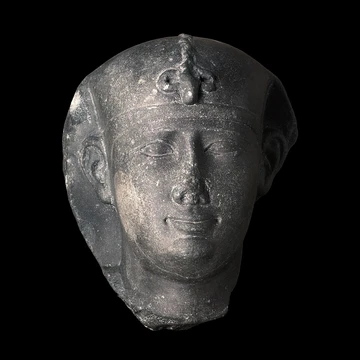
Narmer
Early Egyptian king credited with unifying Upper and Lower Egypt.

Narmer (fl. c. 3100 BC) was an ancient Egyptian king of the Early Dynastic Period, whose reign began at the end of the 4th millennium BC. He is believed to have been the successor to the Protodynastic king Ka, and many scholars consider him the unifier of Egypt and founder of the First Dynasty, and in turn the first king of a unified Egypt. A majority of Egyptologists believe that Narmer was the same person as Menes, the first pharaoh according to the ancient historian Manetho.
- flourished
- c. 3100 BC
- dynasty
- First Dynasty
- predecessor
- Ka
- known_for
- Unification of Upper and Lower Egypt; founder of the First Dynasty
- queen_consort_or_daughter
- Neithhotep
- alternative_identification
- Menes
Lore & Background
Narmer's name is written with hieroglyphs for a catfish (nꜥr) and a chisel (mr), often translated as 'raging catfish' or similar. His name appears in an abbreviated form with just the catfish symbol on pottery and rock inscriptions, while official stone works and seal impressions show both symbols. Two alternative spellings have been found, including one with a duckling symbol interpreted as 'Narmer the masculine', though this is not considered an integral part of the royal name. Two necropolis sealings from Abydos show the name with a catfish bearing a bull's tail, similar to his depiction on the Narmer Palette.
Reader's Guide
Narmer's significance lies in his role as the probable unifier of Egypt and first king of the First Dynasty, a conclusion supported by two necropolis sealings from Abydos that list him as the first king in the correct order of eight First Dynasty rulers. The famous Narmer Palette, discovered at Hierakonpolis, shows him wearing the crown of Upper Egypt on one side and the crown of Lower Egypt on the other, suggesting unification. Narmer also had a prominently noticeable presence in Canaan compared to his predecessors and successors, with his serekhs found in ten sites in Lower Egypt and nine in Canaan. The identification of Narmer with Menes remains a subject of debate, with some evidence pointing to Hor-Aha as Menes, but the majority of Egyptologists favor Narmer.
Did You Know?
- Narmer's name may mean 'painful catfish', 'stinging catfish', 'harsh catfish', or 'fierce catfish'.
- Two necropolis sealings from Abydos list Narmer as the first king of the First Dynasty, followed by Hor-Aha.
- A year label of Narmer from Abydos depicts the same event as the Narmer Palette, supporting its historicity.
- Neithhotep is thought to be either Narmer's queen consort or his daughter.
Unification and Royal Iconography
The Narmer Palette stands as what Egyptologists Bob Brier and A. Hoyt Hobbs have called the oldest Egyptian historical record, a claim that rests on its extraordinary combination of narrative imagery and early hieroglyphic writing. Dating to roughly the 31st century BC, the tablet is widely interpreted as a visual account of the consolidation of Upper and Lower Egypt under a single ruler. What makes this reading particularly compelling is that the king appears on one face wearing the bulbed White Crown associated with the south and on the other face wearing the flat-topped Red Crown of the north. This makes the Palette the earliest known instance of a single ruler depicted in both royal headdresses, effectively encoding the political merger into the very iconography of kingship. At the top of each side, a serekh—a composite symbol representing the king, the crown, and the state's property—bears the phonetic rebus of Narmer's name, rendered as a catfish and a chisel. Together with the Scorpion Macehead and the Narmer Maceheads recovered from the same deposit, the Palette provides one of the earliest surviving visual portraits of an Egyptian monarch.
Discovery and Archaeological Context
Green uncovered what they termed the Main Deposit within the Temple of Horus. From this single stratigraphic layer emerged the Narmer Palette alongside the Narmer Macehead and the Scorpion Macehead, a cluster of objects that together constitute one of the richest pre-dynastic assemblages ever found. The precise circumstances of the discovery, however, remain somewhat murky. Green's own field report placed the Palette in a layer one or two metres away from the deposit, a detail that later researchers have judged more reliable when cross-checked against the original excavation notes. The exact spatial relationship between the three finds was never documented with full clarity. Scholars have suggested the objects were royal donations deposited in the temple, a practice that would fit Hierakonpolis's role as one of four major power centers in Upper Egypt before the political consolidation at the close of the Naqada III period. Although the city's political significance waned in later centuries, its religious importance endured, and the temple complex continued to serve as a focal point for cultic activity well beyond the era that produced these artifacts.
Artistic Conventions and Material Craftsmanship
Carved in low relief from a single slab of dark gray-green greywacke—a finely grained, flake-resistant siltstone sourced from the well-attested Wadi Hammamat quarries—the Palette measures 63 centimetres in height and 42 in width, its shield-like outline giving it a distinctly ceremonial silhouette. The stone was long misidentified as slate or schist, but both of those rock types differ markedly in structure: slate is layered and prone to flaking, while schist contains large, randomly scattered mineral grains. The true material, by contrast, was a workhorse of pre-dynastic palette production and later Old Kingdom statuary; a statue of the second-dynasty pharaoh Khasekhemwy found in the same Hierakonpolis complex was cut from the same stone. The carving itself demonstrates that several hallmarks of Egyptian art were already formalized by the 31st century BC. The king's figure is rendered using the classic multi-perspective convention—feet, legs, and head in strict profile, yet torso, hips, and shoulders turned partially toward the viewer, with one eye shown frontally to maximize information on a flat surface. The proportions follow the established canon of eighteen fist-widths from ground to hairline, a standard that persisted until at least the Macedonian conquest.
Ritual Purpose and Temple Function
Although palettes in the ancient Egyptian world were typically small, handheld tools for grinding pigments and cosmetics, the Narmer Palette is far too large, heavy, and elaborately carved to have served any personal grooming purpose. Its dimensions and the complexity of its relief scenes point instead to a ritual or votive role, most likely created for donation to a temple or use within a sacred precinct. One working theory holds that the palette was employed to grind cosmetic substances for adorning the statues of deities, transforming a mundane act into a devotional service. This interpretation aligns with the broader context of its discovery: the objects were found in the Main Deposit of the Temple of Horus at Hierakonpolis, a site that had been one of four major power centers in Upper Egypt before the Naqada III consolidation. The Palette's survival of roughly five millennia in near-perfect condition testifies to the durability of its greywacke medium and to the careful conditions of its burial.
More in Ancient Egyptian Pharaohs 1-18
Spotted an error? Know more?
This is a living reference — every entry is fact-audited, and reader corrections feed straight into our audit queue. Suggest an edit · See this site's audit record