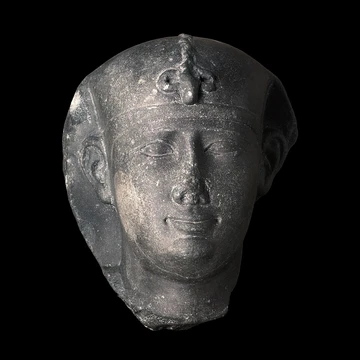
Psamtik II
Saite pharaoh who campaigned in Nubia and built extensively.

Psamtik II (Ancient Egyptian: Nfr-jb-Rꜥ Psmṯk, pronounced Psamāṯək), known by the Graeco-Romans as Psammetichus or Psammeticus, was a king of the Saite-based Twenty-sixth Dynasty of Egypt (595 BC – 589 BC). His prenomen, Nefer-Ib-Re, means 'Beautiful [is the] Heart [of] Re.' He was the son of Necho II. He led a foray into Nubia in 592 BC, marching as far south as the Third or even the Fourth Cataract of the Nile, and sacked the Kushite capital Napata. Later, in 591 BC, he launched an expedition into Palestine to foment a general Levantine revolt against the Babylonians.
- died
- 589 BC
- field
- Monarchy, military leadership, temple building
- nationality
- Egyptian (Saite-based Twenty-sixth Dynasty)
- known_for
- Campaign into Nubia (592 BC), destruction of Kushite monuments, construction of
Lore & Background
Psamtik II led a foray into Nubia in 592 BC, marching as far south as the Third or even the Fourth Cataract of the Nile, according to a contemporary stela from Thebes (Karnak), which dates to Year 3 of his reign and refers to a heavy defeat inflicted upon the kingdom of Kush. A well-known graffito inscribed in Greek on the left leg of the colossal seated statue of Ramesses II at Abu Simbel records: 'When King Psammetichus came to Elephantine, this was written by those who sailed with Psammetichus the son of Theocles, and they came beyond Kerkis as far as the river permits. Those who spoke foreign tongues (Greek and Carians) were led by Potasimto, the Egyptians by Amasis.' The Egyptian army advanced to Pnubs (Kerma) and the capital city of Napata, where they looted its temples and destroyed the royal Kushite statues. The Year 3 Karnak stela states: 'The army that your Majesty sent to Nubia has reached the land of Pnubs....Nubians from all parts [of Kush] had arisen against him...The rebels capitulated before a single arrow was unleashed against them....Those who tried to flee did not succeed and were brought back as prisoners: four thousand two hundred men.' As a result, Kush's power was weakened, and its rulers later shifted their capital south to Meroë. An outcome of this campaign was the deliberate destruction of monuments belonging to the 25th Dynasty Kushite kings in Egypt 'by hacking out their names and the emblems of royalty from their statues and reliefs.' Later, in 591 BC, Psamtik II launched an expedition into Palestine 'to foment a general Levantine revolt against the Babylonians' that involved, among others, Zedekiah of the Kingdom of Judah.
Reader's Guide
Psamtik II reigned only six years but left a significant mark through military action and building. His Nubian campaign ended any immediate Kushite threat to Egypt and led to the relocation of the Kushite capital. He deliberately destroyed monuments of the 25th Dynasty Kushite kings in Egypt. As a builder, he erected a kiosk on Philae island, which today 'represents the oldest known monument known on the island' and consisted 'of a double row of four columns, which were connected by screen walls.' He also had a pair of obelisks more than 21.79 metres high erected in the temple of Heliopolis; the first Emperor of Rome, Augustus, later had one of the obelisks, today known as the Obelisk of Montecitorio, brought to Rome in 10 BC. Psamtik II was also responsible for founding the Temple-house at Hibis in El-Kharga Oasis for the triad of Amun, Mut, and Khonsu, with significant installations for the cult of Osiris. This 19.5 x 26 metre temple featured a hypostyle hall with two-by-two papyrus capital columns, a hall of offerings, three sanctuaries, and a chapel for the cult of Psamtik II. According to Herodotus, Psamtik received ambassadors from Elis who boasted about the Olympic games; the Egyptians advised them to admit only strangers to the contest, not Eleans, to ensure fairness. When Psamtik II died in 589 BC, he was succeeded by Apries, his son by Queen Takhut.
Did You Know?
- Psamtik II's prenomen, Nefer-Ib-Re, means 'Beautiful [is the] Heart [of] Re.'
- A graffito at Abu Simbel records that Greek and Carian mercenaries were led by Potasimto, while Egyptians were led by Amasis, during the Nubian campaign.
- Psamtik II erected a pair of obelisks more than 21.79 metres high at Heliopolis; one was later brought to Rome by Augustus in 10 BC.
- According to Herodotus, Psamtik II advised Elean ambassadors that to make the Olympic games fair, they should admit only strangers, not their own townsmen.
More in Ancient Egyptian Pharaohs 1-18
Related in Ancient Egyptian Pharaohs
Links follow this subject's own source article.
Spotted an error? Know more?
This is a living reference — every entry is fact-audited, and reader corrections feed straight into our audit queue. Suggest an edit · See this site's audit record