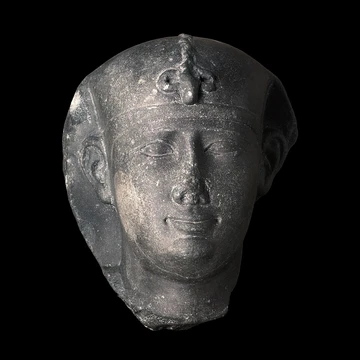
Nyuserre Ini
Sixth ruler of the Fifth Dynasty and prolific builder.

Nyuserre Ini (also Niuserre Ini or Neuserre Ini; in Greek known as Rathurês, Ῥαθούρης; died c. 2422 BC) was an Ancient Egyptian king, the sixth ruler of the Fifth Dynasty during the Old Kingdom period. He is credited with a reign of 24 to 36 years depending on the scholar, and likely lived in the second half of the 25th century BCE. Nyuserre was the most prolific builder of his dynasty, constructing three pyramids for himself and his queens and completing three more for his father, mother, and brother in the necropolis of Abusir. He also built the largest surviving temple to the sun god Ra from the Old Kingdom, named Shesepibre or 'Joy of the heart of Ra.'
- died
- c. 2422 BC
- field
- Pharaoh of Egypt
- nationality
- Ancient Egyptian
- known_for
- Most prolific builder of the Fifth Dynasty; built the largest surviving sun temp
Lore & Background
Nyuserre was the younger son of Neferirkare Kakai and queen Khentkaus II, and the brother of the short-lived king Neferefre. He may have succeeded his brother directly, as indicated by much later historical sources. Alternatively, Shepseskare may have reigned between the two as advocated by Miroslav Verner, albeit only for a few weeks or months at the most. The relation of Shepseskare with Neferefre and Nyuserre remains highly uncertain. Nyuserre was in turn succeeded by Menkauhor Kaiu, who could have been his nephew and a son of Neferefre. Nyuserre built three pyramids for himself and his queens and completed a further three for his father, mother and brother, all in the necropolis of Abusir. He built the largest surviving temple to the sun god Ra constructed during the Old Kingdom, named Shesepibre or 'Joy of the heart of Ra'. He also completed the Nekhenre, the Sun temple of Userkaf in Abu Gorab, and the valley temple of Menkaure in Giza. In doing so, he was the first king since Shepseskaf, last ruler of the Fourth Dynasty, to pay attention to the Giza necropolis, a move which may have been an attempt to legitimise his rule following the troubled times surrounding the unexpected death of his brother Neferefre. There is little evidence for military action during Nyuserre's reign; the Egyptian state continued to maintain trade relations with Byblos on the Levantine coast and to send mining and quarrying expeditions to Sinai and Lower Nubia. Nyuserre's reign saw the growth of the administration, and the effective birth of the nomarchs, provincial governors who, for the first time, were sent to live in the provinces they administered rather than at the pharaoh's court.
Reader's Guide
Nyuserre Ini is significant as the most prolific builder of the Fifth Dynasty, whose construction projects at Abusir, Abu Gorab, and Giza shaped the monumental landscape of the Old Kingdom. His completion of the sun temple of Userkaf and the valley temple of Menkaure reflects a deliberate effort to connect with earlier royal traditions, possibly to legitimize his rule after the disputed succession following his brother Neferefre's unexpected death. His reign also marks a turning point in Egyptian administration, with the effective birth of the nomarchs—provincial governors who lived in their provinces rather than at court—indicating a shift toward decentralized governance. Nyuserre's funerary cult endured for centuries, surviving the First Intermediate Period and lasting into the Twelfth Dynasty of the Middle Kingdom. In parallel, a spontaneous popular cult emerged, venerating him under his birth name 'Iny' as an intercessor between believers and the gods, a practice that continued into the New Kingdom, nearly 1,000 years after his death. This long-lasting veneration underscores his enduring cultural and religious impact beyond his political achievements.
Did You Know?
- Nyuserre's birth name 'Iny' was used in a spontaneous popular cult where he was invoked as an intercessor between believers and the gods, a practice that continued into the New Kingdom nearly 1,000 years after his death.
- He was the first king since Shepseskaf, last ruler of the Fourth Dynasty, to pay attention to the Giza necropolis, completing the valley temple of Menkaure there.
- His reign saw the effective birth of the nomarchs—provincial governors who, for the first time, were sent to live in the provinces they administered rather than at the pharaoh's court.
- Nyuserre's official state-sponsored funerary cult survived the chaotic First Intermediate Period and lasted until the Twelfth Dynasty of the Middle Kingdom.
- The Turin canon's entry for Nyuserre is damaged, but fragments indicate a reign length of somewhere between 11 and 34 years.
Architectural Ambition and the Abusir Complex
Nyuserre Ini stands as the most prolific builder of the entire Fifth Dynasty, a distinction that defines much of his historical footprint. During his tenure he commissioned three pyramids for himself and his queens while simultaneously completing three additional monuments for his father, mother, and brother, all clustered within the Abusir necropolis. His most remarkable architectural achievement was the construction of Shesepibre, meaning 'Joy of the heart of Ra,' which remains the largest surviving temple dedicated to the sun god from the Old Kingdom era. Beyond Abusir, he saw through the completion of the Nekhenre, the sun temple originally begun for Userkaf at Abu Gorab, and finished the valley temple of Menkaure at Giza. This attention to the Giza necropolis was notable because no king since Shepseskaf, the final ruler of the Fourth Dynasty, had directed resources there. Scholars have speculated that this deliberate gesture toward an older royal site may have served as a political statement, reinforcing his legitimacy in the wake of the turbulent circumstances surrounding his brother Neferefre's untimely death.
A Contested Throne
The circumstances of Nyuserre's accession remain one of the most debated questions in Fifth Dynasty Egyptology. Two principal models compete for scholarly favor. The traditional reading, drawing on later historical texts that place him directly after Neferefre, envisions a succession in which Shepseskare reigned for seven years before Neferefre, who then passed the throne to his younger brother. This framework, championed by scholars such as Jürgen von Beckerath and Hartwig Altenmüller, makes Neferefre the father of Nyuserre. A radically different picture emerged from Miroslav Verner's excavations at Abusir in the early 2000s. Verner argued that Neferefre and Nyuserre were full brothers, both sons of Neferirkare Kakai and Queen Khentkaus II, and that Neferefre—likely the eldest son, already in his early twenties at his father's death—succeeded Neferirkare directly. In this scenario Neferefre died after roughly two years, and the brief, uncertain reign of Shepseskare of perhaps a few weeks or months intervened before the young Nyuserre claimed the throne. The precise relationship between Shepseskare and the two brothers remains unresolved, and Nyuserre's own claim may have faced serious challenge from a possible uncle.
A Cult That Outlived the Kingdom
Few Old Kingdom pharaohs achieved a posthumous religious presence as enduring as Nyuserre's. Upon his death an official state-sponsored funerary cult was established, and remarkably this institution persisted through the political fragmentation of the First Intermediate Period and continued into the Twelfth Dynasty of the Middle Kingdom—centuries after his reign had ended. In parallel, a far more organic and personal form of veneration took root among ordinary Egyptians. People began invoking Nyuserre not by his royal throne name but by his birth name, 'Iny,' treating him in a manner strikingly similar to how later cultures would revere a saint. In this popular cult, Iny served as an intercessor, a figure to whom believers turned to mediate between themselves and the gods. This grassroots devotion left almost no material trace in the archaeological record, yet its apparent lifespan stretched all the way to the New Kingdom, nearly a thousand years after Nyuserre's death around 2422 BCE. The coexistence of a formal state cult and a spontaneous popular one makes his afterlife uniquely layered among Old Kingdom rulers.
Governance, Trade, and the Birth of Provincial Rule
Nyuserre's reign was marked less by military conquest than by the quiet expansion of Egypt's administrative and economic machinery. There is scant evidence of significant military campaigns during his years on the throne; instead the state maintained its established trade networks with Byblos on the Levantine coast and continued dispatching mining and quarrying expeditions to Sinai and Lower Nubia. The most consequential administrative development of his era was the effective creation of the nomarchs, provincial governors who for the first time in Egyptian history were posted to reside in the very provinces they oversaw rather than remaining at the pharaoh's court. This shift decentralized a degree of local authority and set a structural precedent that would shape Egyptian governance for generations. Nyuserre's contemporaries, including his manicurists Khnumhotep and Niankhkhnum, high officials such as Khufukhaf II and Ty, and priests of his funerary cult like Nimaatsed and Kaemnefert, are all attested in tomb inscriptions, offering a vivid snapshot of the bureaucratic world that flourished under his rule.
More in Ancient Egyptian Pharaohs 1-18
Spotted an error? Know more?
This is a living reference — every entry is fact-audited, and reader corrections feed straight into our audit queue. Suggest an edit · See this site's audit record