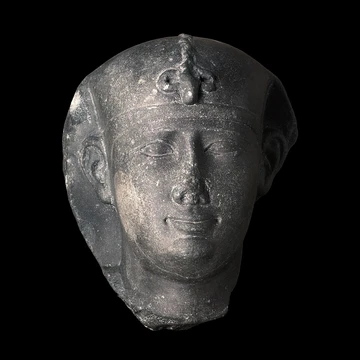
Nectanebo I
Founder of Egypt's last native dynasty, a builder and defender.

Nectanebo I (Egyptian: Nḫt-nb.f; Ancient Greek: Νεκτάνεβις Nectanebis; died 361/360 BC) was an ancient Egyptian pharaoh and the founder of the last native dynasty of Egypt, the 30th Dynasty. He was an army general from Sebennytos who came to power by overthrowing, and possibly putting to death, the last pharaoh of the 29th Dynasty, Nepherites II. He carried out his coronation in c. 379/378 BC in both Sais and Memphis, and shifted the capital from Mendes to Sebennytos. His reign is noted for extensive temple building and restoration, as well as a successful defense against a Persian invasion in 374/373 BC.
- died
- 361/360 BC
- field
- Pharaoh
- nationality
- Ancient Egyptian
- known_for
- Founder of the 30th Dynasty; great builder and restorer of temples; defeated Per
- reign_started
- c. 379/378 BC
- dynasty
- 30th
Lore & Background
Nectanebo I was an army general from Sebennytos, son of an important military officer named Djedhor and of a lady whose name is only partially recorded, [...]mu. A stele found at Hermopolis provides some evidence that he came to power by overthrowing, and possibly putting to death, the last pharaoh of the 29th Dynasty Nepherites II. It has been suggested that Nectanebo was assisted in the coup by the Athenian general Chabrias. Nectanebo carried out the coronation ceremony in c. 379/378 BC in both Sais and Memphis, and shifted the capital from Mendes to Sebennytos. He showed little regard for both Nepherites II and his father Achoris, calling the former inept and the latter a usurper. He seemed to have had a higher regard for Nepherites I. Nectanebo had two known sons: Teos, who was his appointed successor, and Tjahapimu.
Reader's Guide
Nectanebo I holds significance as the founder of the 30th Dynasty, the last native Egyptian dynasty. His reign marked a period of cultural and religious revival, with extensive temple construction and restoration that reinforced traditional Egyptian piety and the power of the priesthood. His successful defense against a major Persian invasion in 374/373 BC preserved Egyptian independence for several decades. By shifting the capital to Sebennytos and restoring the practice of co-regency, he attempted to stabilize the succession, though his son Teos was eventually overthrown by Nectanebo's grandson, Nectanebo II. His building projects, such as the temple of Isis at Philae and the First Pylon at Karnak, left a lasting architectural legacy. The decree at Naucratis illustrates his support for the priesthood and the economy of temple institutions. Despite his achievements, his tomb, sarcophagus, and mummy have never been found.
Did You Know?
- Nectanebo I's Egyptian personal name was Nḫt-nb.f (Nakhtnebef), meaning 'the strong one of his lord'.
- He came to power by overthrowing, and possibly putting to death, the last pharaoh of the 29th Dynasty, Nepherites II.
- In 374/373 BC, he faced a Persian army of over 200,000 troops and around 500 ships, but turned certain defeat into victory.
- A decree from his first year required that 10 percent of taxes from imports and local production at Naucratis go to the temple of Neith at Sais.
- His tomb, sarcophagus, and mummy have never been found.
Accession and the Founding of the 30th Dynasty
Nectanebo I rose to power not through royal bloodline but through military ambition. A general from the Delta city of Sebennytos, he was the son of a senior officer named Djedhor and a woman whose name survives only in fragments. A stele discovered at Hermopolis suggests he seized the throne by overthrowing—and possibly executing—the final ruler of the 29th Dynasty, Nepherites II, with the assistance of the Athenian general Chabrias. Around 379/378 BC, he performed his coronation in both Sais and Memphis, then moved the administrative capital from Mendes to his home base at Sebennytos. His attitude toward his predecessors was pointedly dismissive: he labeled Nepherites II inept and his father Achoris a usurper, while showing somewhat warmer regard for Nepherites I. Though earlier scholars thought Nepherites I might have been Nectanebo's own father or grandfather, that reading now appears to stem from a misreading of the Demotic Chronicle. He left two known sons, Teos and Tjahapimu, and in doing so founded the 30th Dynasty—the last dynasty in Egyptian history ruled by native Egyptians.
Building Program and Religious Patronage
Nectanebo I launched a construction and restoration program unmatched in Egypt for centuries. At the sacred island of Philae near Aswan, he erected the vestibule of what would become the temple of Isis, one of the most significant religious sites in the ancient world. At Karnak, he began the First Pylon within the Precinct of Amun-Re, and scholars believe the earliest known mammisi, discovered at Dendera, also dates to his reign. Archaeological evidence at Hermopolis, Hermopolis Parva, Saft el-Hinna, and Mendes confirms his active support for the cult of sacred animals, a practice that flourished between the two Persian occupations. His generosity extended directly to the priesthood: a first-year decree found at Naucratis, with a twin recently recovered from the submerged city of Heracleion, directed that ten percent of import and local production taxes be allocated to the temple of Neith at Sais. A stele placed before a pylon of Ramesses II at Hermopolis itemizes his donations to local deities, and additional benefits were granted to the Horus priesthood at Edfu. Further building work is attested at Memphis, Tanis, and El Kab. This prodigality simultaneously expressed piety and financially empowered the wealthiest landholders in the country.
Repelling the Persian Invasion of 374/373 BC
In 374/373 BC, the Achaemenid king Artaxerxes II, who still regarded Egypt as a rebellious satrapy, mounted a massive reconquest after six years of preparation. He pressured Athens to recall the Greek general Chabrias and then dispatched an army of over 200,000 troops—Persian soldiers and Greek mercenaries alike—along with roughly 500 ships, commanded jointly by the Athenian Iphicrates and the Persian Pharnabazus. Nectanebo responded by ordering fortifications along the Pelusiac branch of the Nile, forcing the enemy fleet to navigate the less-defended Mendesian branch instead. Once the two commanders found themselves in Egyptian territory, deep-seated mutual distrust between Iphicrates and Pharnabazus paralyzed their coordination, preventing them from reaching Memphis. The annual Nile flood then swelled the waters, and the determined resolve of the Egyptian defenders turned what had seemed like certain annihilation into a decisive victory. Emboldened, Nectanebo subsequently channeled resources toward the western satrapies that began rebelling against Artaxerxes from 368 BC onward, while re-establishing diplomatic ties with both Sparta and Athens.
Succession, Betrayal, and the Naming Legacy
Nectanebo I died in his nineteenth regnal year, around 361/360 BC, and neither his tomb, sarcophagus, nor mummy has ever been located. Toward the end of his reign, in Year 16 (364/363 BC), he attempted to stabilize the succession by reviving the long-dormant practice of co-regency, formally associating his son Teos with the throne. The arrangement, however, proved short-lived. Shortly after Teos assumed power, his brother Tjahapimu betrayed him and maneuvered his own son, Nakhthorheb—known in Greek sources as Nectanebo II—onto the Egyptian throne. This dynastic tangle created a persistent naming confusion in modern scholarship: English convention assigns the identical name 'Nectanebo' to both the founder and the grandson, yet their actual Egyptian names were distinct. Nectanebo I's personal name, Nḫt-nb.f (Nakhtnebef), translates as 'the strong one of his lord,' while Greek writers rendered it variously as Nectanebis or Nectanebēs, the latter spelling in Manetho's text likely reflecting a phonetic approximation shaped by iotacism. Despite the turbulent succession that followed, his dynasty endured as the final native ruling house of Egypt.
More in Ancient Egyptian Pharaohs 1-18
Spotted an error? Know more?
This is a living reference — every entry is fact-audited, and reader corrections feed straight into our audit queue. Suggest an edit · See this site's audit record