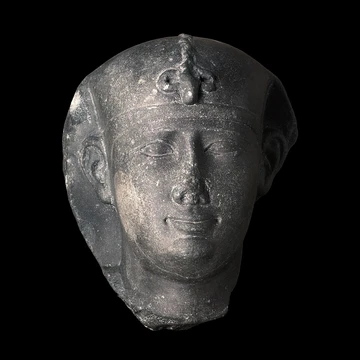
Ptolemy II Philadelphus
Ptolemaic pharaoh who promoted Alexandria's cultural zenith.

Ptolemy II Philadelphus was the pharaoh and basileus of the Ptolemaic Kingdom from 284 to 246 BC. He was the son of Ptolemy I, the Macedonian general of Alexander the Great who founded the Ptolemaic Kingdom after the death of Alexander, and Queen Berenice I, originally from Macedon. During his reign, the material and literary splendour of the Alexandrian court was at its height. He promoted the Museum and Library of Alexandria. In addition to Egypt, Ptolemy's empire encompassed much of the Aegean and Levant. He pursued an aggressive and expansionist foreign policy with mixed success.
- born
- 309/308 BC on the island of Kos
- died
- 28 January 246 BC
- field
- Pharaoh and basileus of the Ptolemaic Kingdom
- nationality
- Macedonian (Ptolemaic Kingdom)
- known_for
- Promoting the Museum and Library of Alexandria; sibling marriage to Arsinoe II;
Lore & Background
Ptolemy II was the son of Ptolemy I and his third wife, Berenice I. He was born on the island of Kos in 309/308 BC, during his father's invasion of the Aegean in the Fourth Diadoch War. He had two full sisters, Arsinoe II and Philotera. Ptolemy was educated by a number of the most distinguished intellectuals of the age, including Philitas of Cos and Strato of Lampsacus. At his birth, his older half-brother Ptolemy Keraunos was the heir presumptive. As Ptolemy II grew older a struggle for the succession developed between them, which culminated in Ptolemy Keraunos' departure from Egypt around 287 BC. On 28 March 284 BC, Ptolemy I had Ptolemy II declared king, formally elevating him to the status of co-regent. The co-regency between Ptolemy II and his father continued until the latter's death in April–June 282 BC. One ancient account claims that Ptolemy II murdered his father, but other sources say that he died of old age, which is more likely given that he was in his mid-eighties.
Reader's Guide
Ptolemy II's reign marked the height of Alexandrian court splendour, with his patronage of the Museum and Library of Alexandria. His aggressive foreign policy expanded Ptolemaic power into Cilicia and Caria during the First Syrian War (275–271 BC) against the Seleucid Empire, though he lost control of Cyrenaica after the defection of his half-brother Magas. The Chremonidean War (c. 267–261 BC) against Antigonid Macedonia for control of the Aegean resulted in serious setbacks, and the Second Syrian War (260–253 BC) saw many gains from the first war lost. His marriage to his full sister Arsinoe II, while shocking to Greeks, conformed to Egyptian pharaonic tradition and set a precedent for later Ptolemaic monarchs. His Nubian campaign around 275 BC annexed the Dodekaschoinos and secured gold mines at Wadi Allaqi, contributing to Ptolemaic prosperity. He also cleared and restored a canal from the Nile near Bubastis to the Gulf of Suez in 270/269 BC, and established the city of Arsinoe at its mouth.
Did You Know?
- Ptolemy II was given the epithet 'Philadelphos' (sibling-lover) after marrying his full sister Arsinoe II, a practice shocking to Greeks but conforming to Egyptian pharaonic tradition.
- The poet Sotades, who mocked Ptolemy II's sibling marriage, was exiled and assassinated.
- Ptolemy II hired 4,000 Galatian mercenaries, but when they mutinied he marooned them on a deserted island in the Nile where they perished by one another's hands or by famine.
- Around 275 BC, Ptolemy II's forces invaded Nubia and annexed the northern twelve miles of territory, known as the Dodekaschoinos, which included rich gold mines at Wadi Allaqi.
- Ptolemy II cleared and restored a canal from the Nile near Bubastis to the Gulf of Suez in 270/269 BC, and established the city of Arsinoe at its mouth.
More in Ancient Egyptian Pharaohs 1-18
Spotted an error? Know more?
This is a living reference — every entry is fact-audited, and reader corrections feed straight into our audit queue. Suggest an edit · See this site's audit record