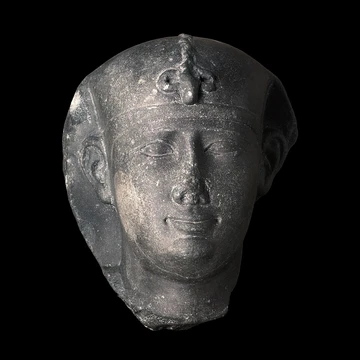
Nectanebo II
Last native pharaoh of Egypt, defeated by Achaemenids.

Nectanebo II was the last native ruler of ancient Egypt, as well as the third and last pharaoh of the Thirtieth Dynasty, reigning from 358 to c.340 BC. His Egyptian name was Nḫt-ḥr-Ḥbt (Nakht-hor-hebyt), meaning "victorious is Horus of Hebyt." During his reign, Egyptian artists developed a specific style that left a distinctive mark on the reliefs of the Ptolemaic Kingdom. Like his indirect predecessor Nectanebo I, Nectanebo II showed enthusiasm for many of the cults of the gods within ancient Egyptian religion, and more than a hundred Egyptian sites bear evidence of his attention.
- born
- Unknown
- died
- Unknown (fate unknown after fleeing to Nubia)
- field
- Pharaoh of Egypt
- nationality
- Egyptian
- known_for
- Last native ruler of ancient Egypt; extensive temple building; defeat by Achaeme
Lore & Background
Nectanebo II rose to power during a campaign against Persia, accompanying his uncle Teos. When Teos imposed heavy taxes and seized temple property, the priests and people supported Nectanebo. After Teos fled, Nectanebo contended with a pretender from Mendes, but with the aid of Spartan general Agesilaus, he suppressed the revolt in the fall of 360 BC. His reign saw a flourishing of Egyptian art that influenced later Ptolemaic reliefs, and he showed great enthusiasm for the cults of the gods, with over a hundred Egyptian sites bearing evidence of his attention. He built and improved temples across the country, notably at Sebennytos, and issued a decree forbidding stone quarrying in the 'Mysterious Mountains' at Abydos.
Reader's Guide
Nectanebo II's significance lies in his role as the last native pharaoh of Egypt, marking the end of an era of indigenous rule before the country fell under Achaemenid control. His building campaigns, though overshadowed by his political defeat, were extensive and left a lasting mark on Egyptian religious architecture and art, particularly influencing the reliefs of the Ptolemaic Kingdom. He successfully defended Egypt against Persian attempts at reconquest for several years, notably defeating an Achaemenid invasion around 351 BC, but was ultimately betrayed by his former servant Mentor of Rhodes. After his defeat in 342 BC, he fled to Nubia, where he was granted asylum but made a vain attempt to regain the throne with the help of Khabash. His subsequent fate is unknown, and his legacy is preserved in archaeological evidence, including a greywacke statue in the Metropolitan Museum of Art and a sarcophagus now in the British Museum.
Did You Know?
- Nectanebo II's Egyptian name, Nḫt-ḥr-Ḥbt, means 'victorious is Horus of Hebyt.'
- Medieval Arab authors referred to him as Nāqāṭānībās.
- He was acclaimed 'Nectanebo the divine falcon' after defeating the Achaemenids around 351 BC.
- A seven-ton sarcophagus originally believed to be Alexander the Great's was found to bear the cartouche of Nectanebo II.
- He was betrayed by his former servant Mentor of Rhodes, who had been sent to aid a Phoenician rebellion.
Rise to Power and the Mendes Crisis
Nectanebo II's path to the throne was forged in political chaos. When his uncle Teos, the reigning pharaoh, faced mounting opposition after imposing heavy taxes and seizing temple property to fund a war effort, the priestly class turned against him. Teos, desperate, sought foreign military aid from Spartan leader Agesilaus and Athenian general Chabrias, but both ultimately abandoned him. Teos fled to the Achaemenid court, where he later died of natural causes. In the power vacuum that followed, Nectanebo II emerged as the favored candidate, backed by the very priests who had resented Teos. His claim was immediately challenged by an unnamed pretender from Mendes, likely a descendant of the earlier Nepherites I dynasty, who had ruled that Delta town before. The usurper attempted to win over Agesilaus, but the Spartan general remained loyal to Nectanebo, unwilling to appear a turncoat. At a town in the Nile Delta, Nectanebo's forces, though outnumbered, broke through a siege laid by the pretender's sympathizers. By the autumn of 360 BC, the revolt was crushed, and Nectanebo's grip on the throne was secured.
Religious Devotion and Artistic Legacy
Nectanebo II's reign left a distinctive mark on Egyptian religious and artistic life. He opened his rule by presiding over the funeral of an Apis bull in Memphis, where he also added relief decorations to the eastern and western temples of Apis. His building and dedicatory campaigns touched more than a hundred sites across the country, including a temple of Khnum at Abu, a sanctuary of Amun at Sekhtam, and a diorite naos dedicated to Anhur-Shu. He was particularly instrumental in elevating the Buchis cult to greater prominence and issued a decree protecting the sacred 'Mysterious Mountains' of Abydos from stone quarrying. Beyond construction, his era saw Egyptian artists develop a specific stylistic vocabulary in relief work that would continue to influence the visual language of the Ptolemaic Kingdom long after his fall. Like his predecessor Nectanebo I, he demonstrated a broad enthusiasm for the diverse pantheon of Egyptian deities, ensuring that his patronage was felt across the religious landscape rather than concentrated in a single cult center.
The Divine Falcon and Military Triumph
Nectanebo II's most celebrated military achievement came around 351 BC, when the Achaemenid Empire launched yet another bid to reclaim Egypt. The Achaemenids had previously attempted reconquest in 385, 383, and 373 BC, making Nectanebo's success all the more remarkable. Following a year of intense fighting, Nectanebo, supported by allied Greek generals Diophantus of Athens and Lamius of Sparta, delivered a decisive victory over the Persian forces. The triumph was so overwhelming that his people hailed him with the title 'Nectanebo the divine falcon,' and personal cults were raised in his honor—a remarkable elevation that blurred the line between pharaoh and deity. This victory was not achieved in isolation; Nectanebo had used the preceding years of relative peace to rebuild Egypt's military capacity, employing Greek mercenaries in line with contemporary practice. His defensive strategy was comprehensive: flat-bottomed boats were positioned to block enemy access to the Nile mouths, while strongholds, fortifications, and entrenched camps lined the vulnerable Mediterranean and eastern frontiers. The prestige of this campaign cemented his reputation as the last native pharaoh to successfully defend Egypt against the great Persian power.
Betrayal, Defeat, and the Unknown End
The final chapter of Nectanebo II's story is one of treachery and tragic loss. In 345/44 BC, he had dispatched 4,000 Greek mercenaries under Mentor of Rhodes to support a Phoenician rebellion against the Achaemenids, led by Tennes, king of Sidon. But upon learning of Artaxerxes III's approaching army, Mentor opened secret communications with the Persians in collusion with Tennes, effectively turning the Egyptian ally into a Persian asset. By the winter of 343 BC, Artaxerxes marched on Egypt with forces bolstered by Mentor's intimate knowledge of Egypt's eastern defenses and an additional 6,000 Ionian troops. Nectanebo fielded an army of 60,000 Egyptians, 20,000 Libu, and as many Greek mercenaries, yet the betrayal proved fatal. In the summer of 342 BC, Artaxerxes entered Memphis and installed a satrap, folding Egypt back into the Achaemenid Empire. Nectanebo fled south, eventually reaching Nubia, where King Akhraten granted him asylum. There, with the aid of a figure named Khabash, he made one last, futile bid to reclaim his throne. What became of him afterward is lost to history.
More in Ancient Egyptian Pharaohs 1-18
Spotted an error? Know more?
This is a living reference — every entry is fact-audited, and reader corrections feed straight into our audit queue. Suggest an edit · See this site's audit record