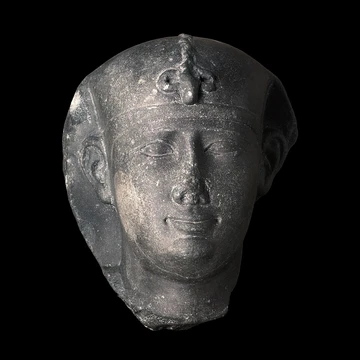
Ptolemy XII Auletes
Ptolemaic king who played the flute and relied on Rome.

Ptolemy XII Neos Dionysus, commonly known as Auletes (the Flautist), was a king of the Ptolemaic Kingdom of Egypt who ruled from 80 to 58 BC and then again from 55 BC until his death in 51 BC. He was a member of the Ptolemaic dynasty, a descendant of its founder Ptolemy I, a Macedonian Greek general and companion of Alexander the Great. He was an illegitimate son of Ptolemy IX by an uncertain mother. He was recalled from Pontus and proclaimed pharaoh after the killing of his cousin Ptolemy XI in 80 BC, while his brother became king of Cyprus. His reign was marked by political instability, reliance on Rome, and the eventual rise of his daughter Cleopatra VII.
- born
- c. 117 BC
- died
- 51 BC
- nationality
- Ptolemaic Egyptian (Macedonian Greek descent)
- known_for
- Playing the flute in Dionysian festivals; being deposed and restored with Roman
Lore & Background
Ptolemy XII was an illegitimate son of Ptolemy IX by an uncertain mother. He was recalled from Pontus and proclaimed pharaoh after the killing of his cousin Ptolemy XI in 80 BC, while his brother became king of Cyprus. He married his relative Cleopatra V, who was likely one of his sisters or cousins; they had at least one child together, Berenice IV, and Cleopatra V was likely also the mother of his second daughter, Cleopatra VII. His three youngest children—Arsinoe IV, Ptolemy XIII, and Ptolemy XIV—were born to an unknown mother. Ptolemy XII's uncle Ptolemy X had left Egypt to Rome in the event there were no surviving heirs, making Roman annexation of Egypt a possibility. In an effort to prevent this, Ptolemy XII established an alliance with Rome late into his first reign. Rome annexed Cyprus in 58 BC, causing Ptolemy of Cyprus to commit suicide. Shortly afterwards, Ptolemy XII was deposed by the Egyptian people and fled to Rome, and his eldest daughter, Berenice IV, took the throne. With Roman funding and military assistance, Ptolemy XII recaptured Egypt and had Berenice IV killed in 55 BC. In the last year of his reign, his daughter Cleopatra VII was appointed as his regent. Upon his death, he was succeeded by Cleopatra VII and her brother Ptolemy XIII as joint rulers.
Reader's Guide
Ptolemy XII Auletes is significant primarily as the father of Cleopatra VII and as a ruler whose actions deepened Roman involvement in Egypt. His pro-Roman policy, including bribing Roman politicians and seeking military aid, was driven by the threat of annexation stemming from Ptolemy X's will. In 60 BC, Ptolemy XII travelled to Rome, where the First Triumvirate, composed of Pompey, Crassus, and Julius Caesar, had just taken power, in order to negotiate official recognition of his kingship. Ptolemy paid Pompey and Caesar six thousand talents – an enormous sum, equivalent to the total annual revenue of Egypt. In return, a formal alliance or foedus was formed. The Roman Senate recognised Ptolemy as king and Caesar passed a law that added Ptolemy to the list of friends and allies. His deposition and restoration with Roman help set a precedent for Roman intervention in Ptolemaic affairs. His reign also saw the loss of Cyprus to Rome and the execution of his own daughter Berenice IV. Despite his efforts to secure the dynasty, his reliance on Rome weakened Egyptian sovereignty and paved the way for the eventual Roman takeover after Cleopatra VII's death. His epithet Neos Dionysos and his love of flute-playing in festivals reflect his attempts to bolster his legitimacy through religious and cultural associations.
Did You Know?
- Ptolemy XII was commonly known as Auletes (the Flautist), referring to his love of playing the flute in Dionysian festivals.
- He paid Pompey and Caesar six thousand talents – an enormous sum, equivalent to the total annual revenue of Egypt – to secure a formal alliance with Rome in 60 BC.
- Rome annexed Cyprus in 58 BC, causing Ptolemy of Cyprus (his brother) to commit suicide.
- Ptolemy XII was deposed by the Egyptian people and fled to Rome, and his eldest daughter Berenice IV took the throne; he later recaptured Egypt with Roman help and had her killed in 55 BC.
- In the last year of his reign, his daughter Cleopatra VII was appointed as his regent.
More in Ancient Egyptian Pharaohs 1-18
Spotted an error? Know more?
This is a living reference — every entry is fact-audited, and reader corrections feed straight into our audit queue. Suggest an edit · See this site's audit record